Portals
Lodestar learns portal connections by watching you use them. Once it knows one, a destination in another dimension is no longer a dead end: Lodestar guides you to the portal first, then on to the place after you step through.
How portals are learned
Section titled “How portals are learned”Walk through a portal to another dimension. Lodestar notices that you were standing in a portal just before the dimension changed, remembers where you went in and where you came out, and says “Lodestar remembered this portal connection.”
- Each direction is learned separately. Going from the Overworld to the Nether teaches that way only; come back through the portal to teach the return trip.
- Changing dimension with a command, or respawning after death, does not teach a portal.
- Lodestar never guesses where a portal you have not used will lead, and does not assume the Nether’s usual eight-to-one coordinate scale.
- It does not find portals for you, open new ones, or teleport you.
Guiding to another dimension
Section titled “Guiding to another dimension”Choose a destination in another dimension. If Lodestar has learned a way there, your guide leads to the portal’s entrance in your current dimension. After you step through, it recalculates and guides you on, through more learned portals if the trip needs them.
If no learned portal leads there, the guide hides and Lodestar says, for example, “Your Lodestar destination is in the Nether. Guidance will resume when you return there.” The Lodestar menu shows the dimension’s name in place of a distance.
The Portals tab
Section titled “The Portals tab”Open My outings and choose Portals. Each row shows one learned connection: the dimension and position of its entrance, and where it leads, such as “the Overworld at 75, 1 → the Nether”. Select a row to see the exit’s coordinates.
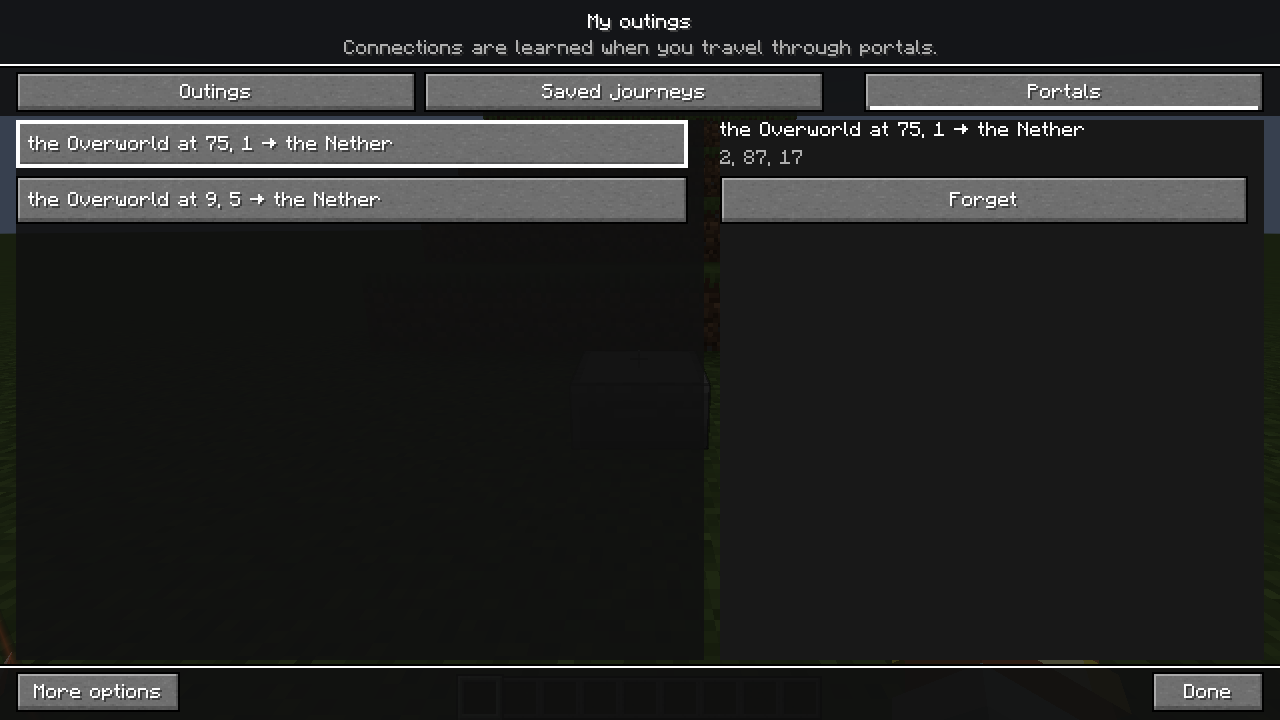
Press Forget to remove a connection; Lodestar asks first. Forget a connection if you broke or moved that portal, then walk through the new one to teach it again.
Lodestar keeps up to 64 connections per world. When it learns another, the oldest is forgotten.